Observations from One Square Mile: Winter
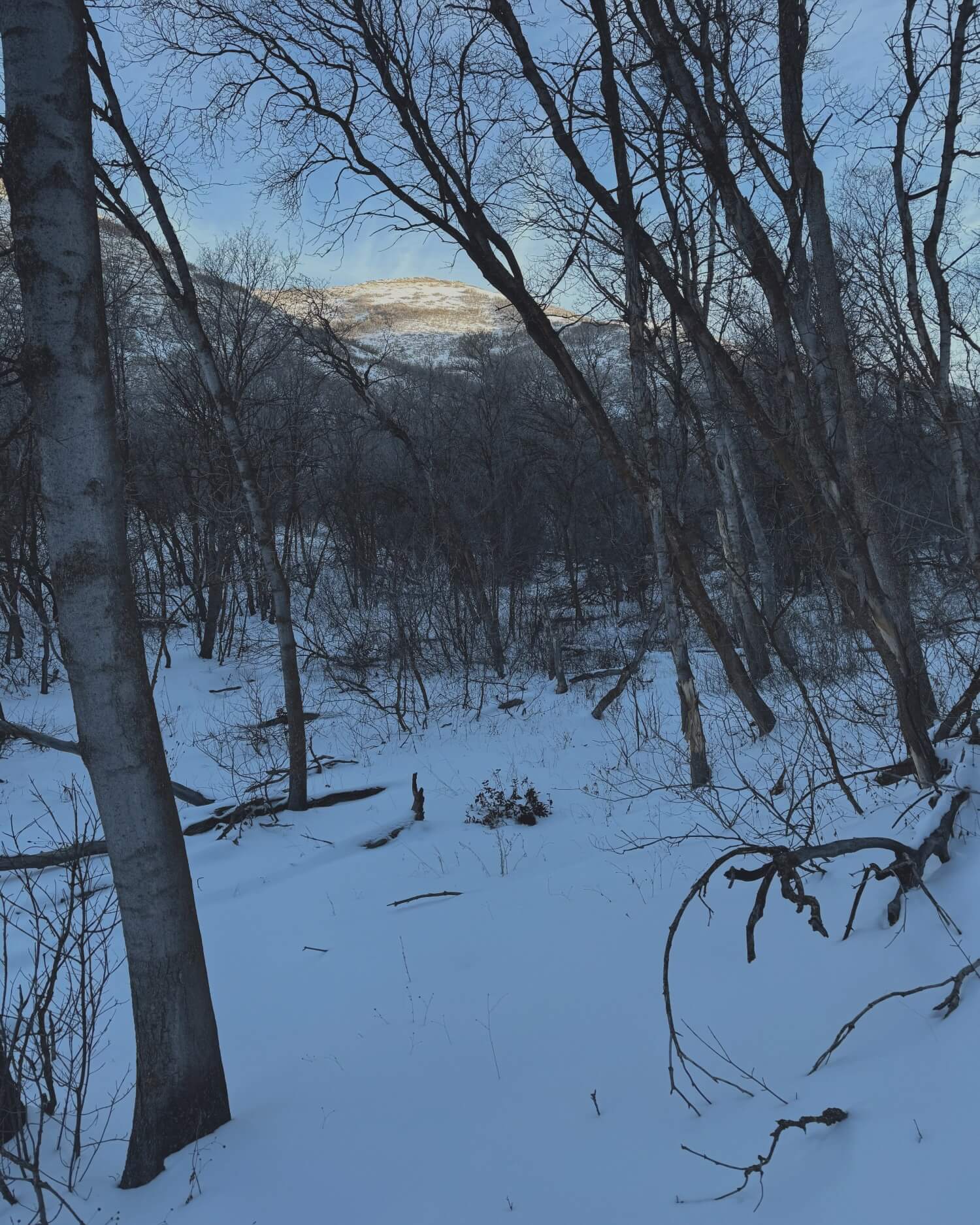
I sit in shade and snow, watching as the sky lightens above the South Ridge. It's cold. My toes ache from the chill and my hands, even in gloves, lose touch when I spend too long writing. The sun is rising, but I wonder if it will make it high enough to break over the ridgeline and reach where I sit. I watch its progress on the hills behind me, alighting upon stilled oak, the demarcation of bright and dim made hazy by thin clouds.
Waiting on this first light takes on a kind of spiritual quality, as if sitting for communion, but instead of the drone of a church organ filling the air it's the winter sun burning off the frost that lies heavy across the land. Patience comes easy in the still of dawn.
This winter has been unseasonably warm for Salt Lake City, with record low snowfall and temperatures hinting at spring far too early. Then, mid-February, the weather took a turn and brought in more snow in an afternoon than the valley had seen all winter. Knowing that this would likely be the last storm of the year, I waited anxiously for the weekend when I would have time to head back into the range. Snow is the blank canvas upon which animals leave their marks, making it the best chance to learn about what lives within my one square mile.
I started the morning hiking up South Fork, my travel slowed by the rocks and branches hidden beneath the powdery snow. A couple weeks prior I found what seemed to be an old mountain lion kill, the ribs, spine, and large leg bones of a deer partially buried under leaves and brush. The bones were dried and cracking, long left to lie, but still a hopeful sign. Mountain lions lay claim to vast swathes of territory, often sixty square miles or more. So even one passing through, on rare occasion to mark and hunt, was an exciting enough prospect to send me back into the canyon hoping that the fresh snow would reveal an otherwise hidden sign. But aside from some deer tracks cutting perpendicular up and out of the creek bed, I found no marks breaking the three-day-old snow.
A lack of tracks hardly diminishes the pleasure of being out alone on this land. The snow holds luminescent blue in complement to the pink sky to the west. Early in the morning there's little traffic from the city to break the quiet, just a soft lull that filters through the trees. The valley beneath the steep South Ridge gets little sun in the winter, so the air keeps a heavy cold undeterred even with two jackets. Once I've reached the corner edge of the range, I weave my way up and out to the north, following gaps within the trees leading to an open patch of hillside. This is where I'll sit until my page brightens yellow like the glow of a candle, as the warmth of the sun touches down from all those millions of miles away.
Even in the sun, it's too cold to sit for long. I finish my tea, and after a final scan with my binoculars to make sure nothing is bedded down within sight, it's time to move again. Winter on the range works in my favor. Tracks are easier to find, and without the brush and undergrowth, the hills and oak copses feel as easy to walk through as a manicured garden.
Most days, after sitting in a spot for an hour or so, I head off in various directions, following game trails and other distractions, with little concern of where I'll end up. The freedom to follow my curiosities is a special kind of joy. Typically, my ambitions of reaching a summit or finishing a trail get in the way of this kind of wandering. So with this project I wanted more time to sit and watch and listen. Even if nothing happens, as is so often the case, the act of attention is reward enough.
A ways up the hills, I come across a group of lesser goldfinches, as they pick at the withered edges of the oak. They startle quickly and always keep a mess of bare branches between us. I haven't seen many birds throughout winter, but as February passes there's been more life returning by wing. Magpies were the first to arrive, with their grating, throaty calls just past dawn. Lately, some familiar songbirds have started venturing higher up, black-capped chickadees and lesser goldfinches in the trees, with spotted towhees and robins rooting around on the ground.
As I pass around another clump of oak, there's a faint glint off the snow that catches my eye. Soft imprints, more melted than pressed, a clean coyote track running parallel to a deep-set deer trail. She had traveled west to east, opposite to the direction I've been walking. I'm still near the back edge of the range, so I decide to follow the tracks in reverse, to see the route she had taken through the familiar territory. Each print barely breaks the snow's surface, a sign she passed through well after the storm had ended and the surface had time to refreeze.
Following animal tracks feels like reading a letter from a pen pal. You're communing with a story that's not quite present, but still full enough of life to relate to the original experience. Walking slowly, head bent with frequent stops, I wonder at the intention of the coyote who left these marks behind. Were you hungry? Are you headed home or away? I turn around often to look at what she would've seen. Why this way? The cadence was steady, with little to break its stride aside from the occasional slip and one spot where she stopped twice in short succession, doubling her prints on a narrowing stretch of snow.
Each little print is an encouragement to find the next, one by one until you forget the original direction you were headed and lose all sense of time in pursuit of that next track. Eventually, the coyote's path parted from the deer trail, angling higher up the ridge. But as I climbed up, the snow continued to thin out, until I was walking patch to patch, holding my breath without realizing it, hungry for any small sign to continue on with.
I consider it a lucky day when I see more than a single coyote print in the mud or a patch of snow. So to be able to follow this coyote's path over a half mile of open terrain was more than I could have hoped for.
Once I lost the tracks, I finally took a minute to look around. On the South Ridge, just across from me, a mule deer is taking a zig-zagging line down a steep bank of snow, with the same telltale pattern as a backcountry skier skinning up a mountain. Through my binoculars I see two other deer higher up, standing at the edges of oak, watching the deer's progress below them before making their own way down.
The contrast of the deer's dark body over the white snow makes it easy to pick up their silhouettes. Winter makes it easier on me, both to follow and to spot what's around. But I've rarely seen an animal that hasn't already seen me, and I imagine those I've missed count in the dozens. And that's with no leaves on the trees and the grass cropped low. I can already imagine how difficult it will be once everything grows in full.
But that's a worry for a later day. My time is full with studying tracks and the patterns of life, with gloves fumbling through notebook pages and a beanie that muffles the already hushed calls of morning birds. Seasons are an opportunity for gratitude, in what they provide, and in the changes they foretell. Winter, light as it was, has provided plenty.
Now I look forward to the green and heat of the months that will stretch out ahead.
Read the first essay in the series: Into the Hills.