Observations from One Square Mile: Among the Rocks
I wasn't quite sure how to begin writing about rocks. It's easy to take them for granted. In the range, unlike many of the other areas in the Wasatch Mountains, rocks aren't the star of the show. There are no dramatic peaks or unbroken faces to seek out. But their presence is nonetheless persistent, underfoot in creek beds and littering the hillsides, a swatch book of matte grays and faded reds, covered in lichen or breaking into sandy sluff. One morning, while sitting and sipping tea, I counted thirty-one distinct rocks within reach.
In nature, little stays the same for long. Week by week, the range is in constant change, an unfolding of detail and life beyond my capacity to note. Animals flee from sight, running over grasses and flowers that will bloom and wither within weeks. Bird species vary between months, and even the locals are sporadic and prone to flight. Trees offer a little more stability, but are still only a seasonal snapshot, budding, rustling, and dying back.
Rocks though, they just sit. With surfaces cracked and crumbling, they weather every storm and sunbaked day. And they don't ask anything of you. You don't need to wake up early to see them, learn their habits, or catch them at the right time of year. They're always around, patiently waiting. But their ubiquity often blurs them into a faceless mass. That's why it felt important to spend some time getting to know them.
I dove into research, spending my evenings reading about geological history. I learned about calcite veins and chert, fault zones and clasts. But after a month, I didn't feel any closer to connecting with all that rock. It felt like cramming for a test, far removed from my time wandering through the mountains.
It wasn't until I was sitting on a ledge out over a small wash, watching the last light of day in the canyon country of Torrey, Utah, that I realized I had been focusing on the wrong details. What I care about is the experience of being next to rocks. Climbing them, sitting on them, their weight in my hands. That's when I feel the connection. History and facts can add depth, but at least for me, they don't add meaning. So I'll leave you with three stories of some rocks I've spent time around in the range.
At the start of my One Square Mile project, the first place I went was up what I called Middle Ridge, named because of its position bisecting the range into two halves. Once high enough on the ridge, I wanted to find a memorable spot, a consistent vantage point I could return to easily. I was immediately drawn to a clump of rocks, poking out of the earth like newly erupted baby teeth.
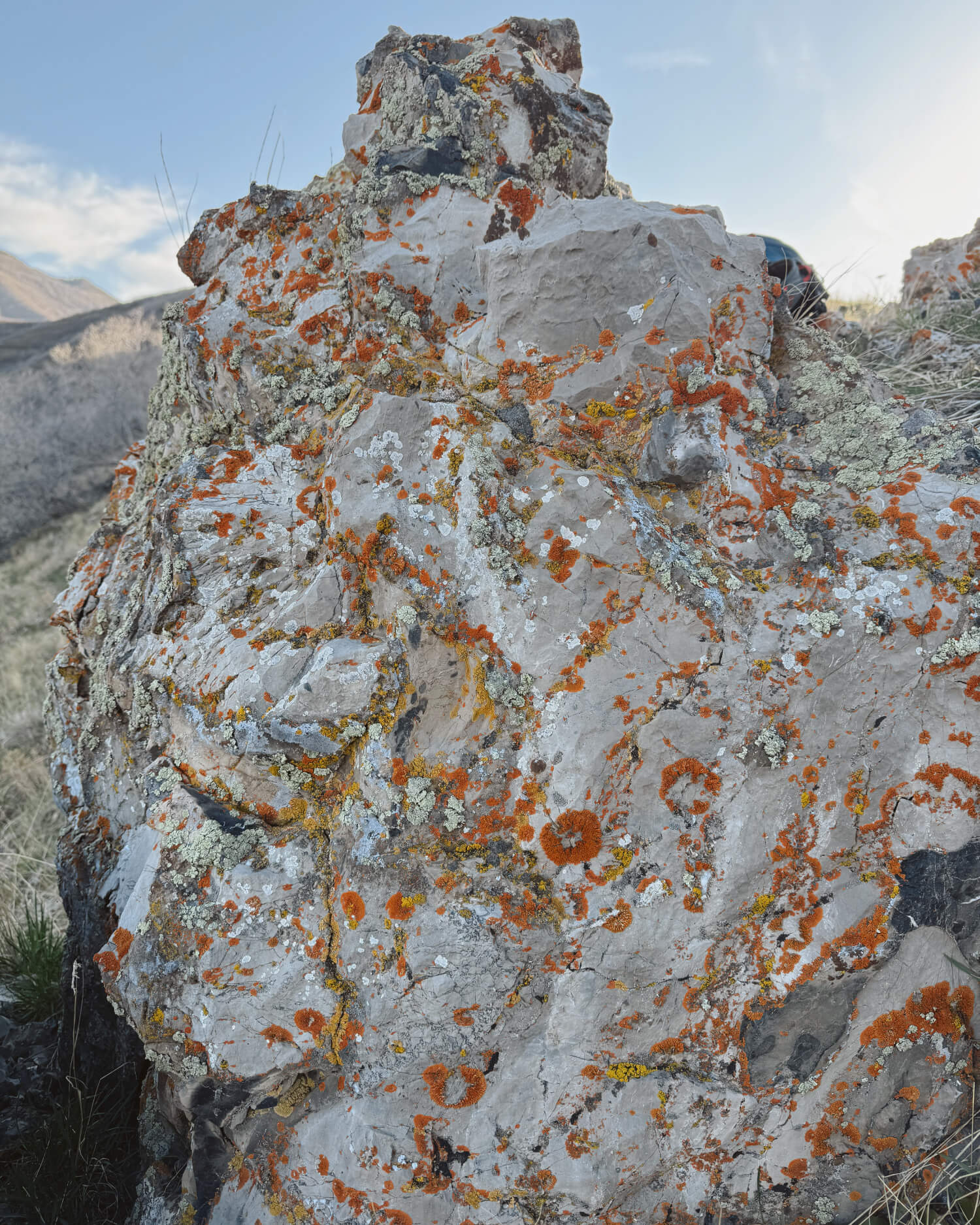
From a distance, the rock looks painted on, with burnt oranges and a staccato of blacks. Up close, lichen reveals further detail, adding sage greens and splattered whites. The rock is jagged at the edges and solid throughout, smooth but with a fine grit to the touch. Geologically, this middle section of the range is referred to as the Park City Formation, Permian rock roughly 270 million years old. This band is made up of limestone and calcareous siltstone, the remnants of a long-settled sea bed.
After a couple visits, I moved my chair down five feet or so from the crest of the ridge, to avoid breaking the skyline and attracting attention from the animals below. To get settled, I first balance the legs of my chair on small stacks of rocks, leveling out the steepness of the slope. Precarious if I have to reach too far for my backpack, but comfortable. Then I put my feet up on the craggy rock and wait for first light. You can smell the rock as it warms in the sun, earthy, but only lightly, in contrast to the musky spring growth that's hard to ignore.
Over the dozen or so hours sitting among these rocks, I've watched deer and turkey, ravens and hawks. I've listened to calls of chukar and mountain chickadees welcoming the rising sun. On most trips to the range, I make sure to swing by, even if only for a few minutes to glass for movement below. I call it Rock Hill, and I feel fonder of this spot than any other.
To the north of Rock Hill, four-tenths of a mile away and downslope, lies a grouping of rocks on the edge of a hill. The rocks are the size of living room furniture, stacked and stretched into a rough line, noticeable from all the surrounding hills. I was eager to check out the spot in person.
I first visited the rocks in January, cold enough that fallen tree trunks held a peach fuzz of frost well into the morning. To get there, I headed up a narrow and overgrown draw on the far northwest corner of the range. A trickle of water runs down it throughout winter. I had seen plenty of deer in the area, so it wasn't long before I picked up a game trail heading uphill.
I could immediately tell this outcrop was different from the limestone of Middle Ridge. It has the look of chunky gravel, with worn rocks the size of baseballs protruding by the dozens. This is conglomerate rock, part of the Hopper Canyon Formation, three to five million years old. Formed by the accumulation of sand and debris, this mass of rocks is cemented together, holding firm as the surrounding landscape continues to wear away.
There was only a little snow left on the ground, hiding on the shadowed north side. But it was enough to tell a story, with coyote tracks going in multiple directions at the base of the rocks, and another line of prints climbing the ledges higher. I followed their path over broken patches of snow until I came upon a hole dug into the ground beneath the lower layer of rock. The dirt was settled enough to make me think it was an older den site, and I couldn't find any entrances around the other side.
A potential den site, at a good viewing distance from Middle Ridge, was an exciting prospect. I knew it was far too early in the season for coyotes to have puppies, but I still left the area straightaway, not wanting to dissuade them from returning. I've since spent hours watching this spot I named Coyote Rock, but I still haven't seen anything other than deer in the area.
Over my months in the range, I had accumulated a mental map of rock features I wanted to explore, and what I'm calling Pool Hall is the last one I visited. It's on the far northeast edge of the range, a long walk up the canyon and a few hundred feet above the North Fork trail. From across the range, its face stands out, with the look of a bulging barrel. The rock has a warm, light color, as if too long left in the sun.
To reach it, I bushwhacked out of North Fork, eventually following a game trail farther up. I passed a lone mountain mahogany, the only one I've seen in the range, standing with the leaning beauty of a bonsai. As I got closer, there was more greenery than I expected, and the sound of running water came from a grove of trees much taller than the surrounding oaks.
In the middle of the hollow was a still pool, clear to the bottom, and fed by a trickling spring coming out of the hillside. The water of the pool was held in by a wall of moss, the width of a balance beam and colored an endless multitude of greens. Around the pool were sprigs of wild spearmint, and a cleft cut into the hillside above, with tree roots hanging down like vines.
I was so surprised at finding this place that I forgot my original reason for hiking up here. But the rock face, peeking through the trees and bright in the sun, called me on. The rock had a wavy, circular pattern that reminded me of coral. Just by touching it I could tell it was sandstone, as its rough, gritty texture rubbed off into my hands. The face itself was twenty feet at the tallest, cleanly rising to the right, then breaking into a jumbled, craggy pile to the left. It's a band of Weber Sandstone, 300 million years old, the porous surface heavily pocked by rain. I licked a piece of the rock. I didn't know what I was expecting, but I was expecting more flavor.
For the first time since I've been in the range, I had a strange, unsettled feeling when sitting at the base of the rock. Maybe it was because I'd spent months glassing this area looking for mountain lions, but I felt like an intruder who had wandered too far off trail. Even though I felt silly, I decided to move back a ways.
It was finally warm enough to sit directly on the ground. I listened to a woodpecker hitting a tree farther up the canyon, and a chukar call out from below. Two pine siskins playfully wheeled through the air, calling to each other with a bright, single note. From here I could see down the entire northern half of the range, out past Coyote Rock and another tall band of limestone on Middle Ridge I explored a couple weeks back.
It's satisfying to look over how much terrain I have crisscrossed these last few months. And this view only holds half of the square mile I've covered. The range is like a wrinkled palm, full of creases and calloused curves. I haven't had enough time yet to build a deep familiarity, but it's starting to sink in, this sense of recognition and the awareness, however slight, of the vastness it contains.
Read the first: Into the Hills and second: Winter in the series.