Observations from One Square Mile: Only One Grove
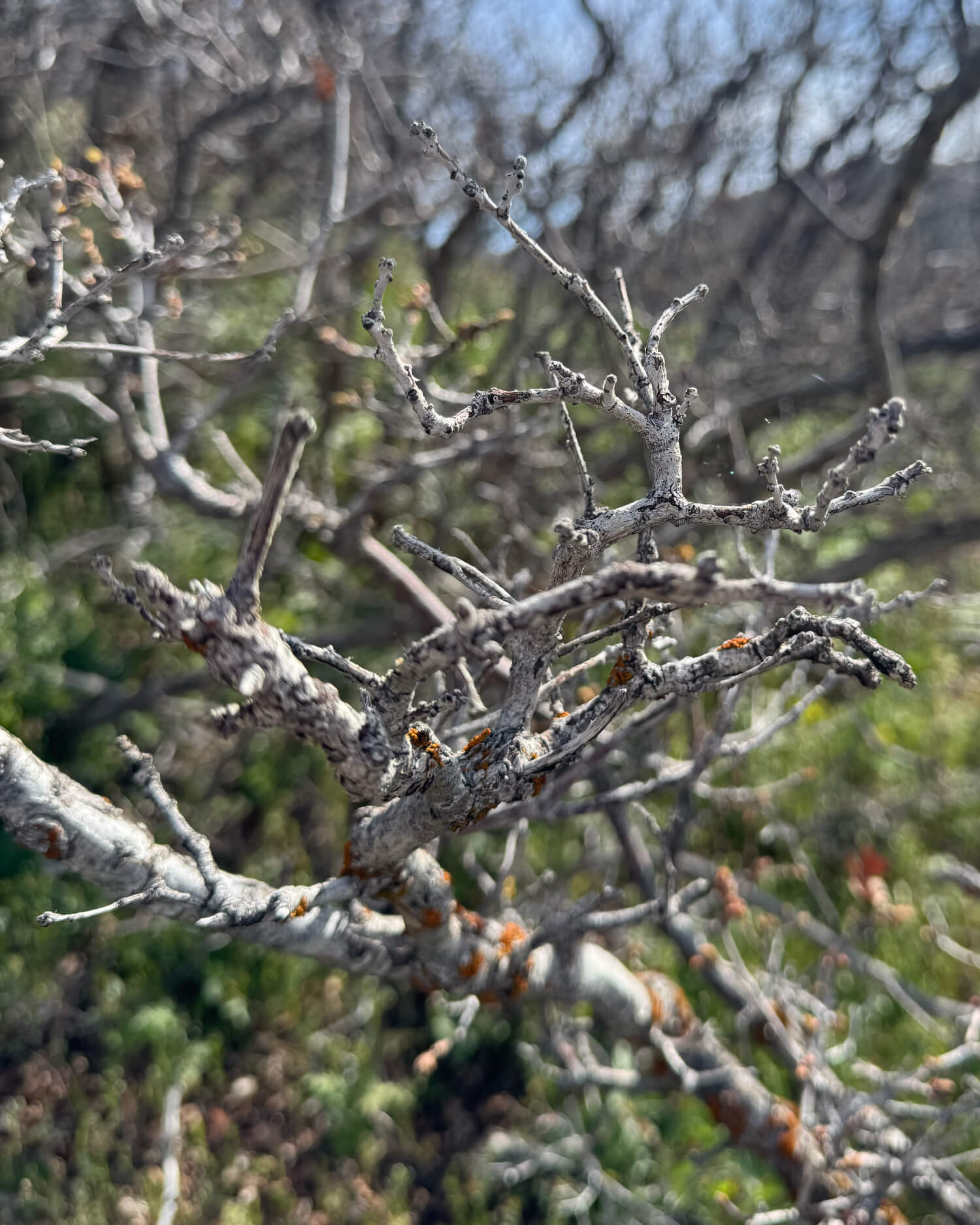
It's difficult, when staring at the same trees week after week, to avoid wondering if this is the best use of my time. With my goal of exploring the variety of an entire square mile, I wasn't sure it made sense to spend so much time in an area only a few dozen feet across. Would it be worth it, especially in the most dynamic season of the year?
Despite my doubts, I decided to spend a month lying within a single grove of oak trees, my eyes at the level of thin twigs, watching as they took leaf around me. Morning to afternoon, I hardly moved, dozing at times, interrupted only by the drumming heartbeat flaps of birds through the brush and the wind giving motion to the hillside.
Two months later, I stood on my balcony and watched as the mountain just to the south of my range was engulfed in flames. As the fire spread closer and closer to my one square mile, I realized that the little oak grove I had just spent all those weeks in could easily be burned to the ground. And maybe I was the last person to get to enjoy those humble trees. That's when I knew the time was worth it, and I was grateful for being able to spend those long hours in their company. It was mundane, and quiet. It was beautiful.
I chose a grove of oak high on the slopes of Middle Ridge, on the southeast side of the range. It's a wide patch, with trees four to eight feet high, too dense to walk through, but not as thick as it looks from a distance. They're Gambel oak, more commonly referred to as scrub oak, the dominant tree throughout the hills.
My first time near the grove, I walked the outside looking for an easy way in. I wanted to be surrounded, not sitting out on an edge. The taller trees lay lower down on the hillside, with their height decreasing as the slope rose. I found a game trail cutting through the middle, disused and growing over. Walking along the trail, I came upon a bare, scraped-out circle, probably a winter bedding site, the perfect size to stretch out in.
On the ground, with my head resting on my pack, I can see nothing but a tangle of trunks and branches, except for forty-five degrees facing southwest. My one view looks down the mouth of South Fork canyon and into the Salt Lake Valley below. It's the beginning of May, and the oaks around me are just starting to show their buds. The few leaves that have unfurled are the length of my pinky nail, soft, in the colors of green and red. Like a baby's fingerprints, the leaves already display their distinct lobed shape, a miniature replica of their adult form.
Before finding this grove, I was worried I would miss the initial oak budding. In mid-April, I walked through some patches of oak that had already begun to send out leaves, mostly on the west side of the range. But I still hadn't found a spot that felt right, and I didn't want to settle for early growth. The next week, a cold snap came in, bringing light snow into the foothills. When I went back up, all the exposed leaves had died, crumbling under my touch.
I wondered what caused such variation among similar trees in similar terrain. One grove was punished for its early growth while others still stood as barren twigs.
The timing of budbreak comes down to two thresholds. First, the tree must accumulate enough chilling hours, roughly between 32 and 50 degrees, to release it from dormancy. Even with the warmer winter, the foothills were plenty cold enough. The second threshold is heat, signaling that the environment is now ready for growth. It should be gradual, a springtime of slowly warming days coaxing the buds to release. But this year in the Wasatch, the weather was unpredictable, with many unusually warm days. These big swings, more pronounced on the sun-exposed west flanks of the range, caused the inconsistent early budding that was then undone by a sudden chill.
The hills could hardly wait to spring fresh growth, regardless of the oaks' lack of success. Arrowleaf balsamroot was first to show. The thick-veined leaves, hand-sized and larger, erupted across the still-sparse hillsides, with bright yellow flowers, one or two to a plant, following quickly behind. While the plants sprouted in scattered clumps, I found the most flowers around the base of the oaks. In a single view within my grove, I counted over twenty. But the arrowleaf's season was short, with flowers lasting only a couple of weeks, and the leaves had already withered away by the end of May.
Along with the flowers, the oak groves also sheltered the webs of funnel weaver spiders. For a few weeks, it was hard to walk without stepping over their dish-towel-sized webs, laid in the grasses and among the trees. Two feet from where I lay, a web stretched out at the base of an oak, its funnel pointing directly at me. When I first sat down, moving my pack and adjusting my jacket and gear, the spider would retreat out of sight. It was as small as a pebble, and fast. But eventually it would venture out, bit by bit, until it sat just outside the funnel. I wondered what it could perceive of me, so close, but in relation to its size, an entire world away. Two weeks later, the spider was gone, its web pocked with holes and in disarray, cluttered with leaf debris and flecks of grass.
The transition from hard, solid wood to soft unfurling leaves seems unbelievable. Bare sticks, for months a dull and lifeless grey, break open in a week, with reddish-orange buds swelling at the tips. Unlike the oaks on the western slopes, this grove didn't sprout early, so the growth of fresh leaves is largely synchronized, with the smaller, lower trees showing first.
Alongside the new leaves come birds by the dozen. From where I lie, the bulk of the grove is behind me. So it's their shadows flitting through the trees that I see more than the birds themselves. But I'm surrounded by calls, near and far, overlapping and rising above the wind and rustle of branches.
Lazuli buntings, with a head of striking cerulean blue, have the brightest ringing call. Then there's the lark sparrow, with a long complex song that reminds me of the bells and trills from a vintage pinball machine. Spotted towhees and chipping sparrows round out the register, with lower notes and more repetition. When the wind is still, I can hear them flying. Such small birds, flapping so hard to stay alight.
A hummingbird, in a sudden flash of noise and motion, startles me one morning, nearly within reach, hovering at eye height. Its body holds so still the wings disappear entirely, and for a few seconds it looks straight at me, before zipping out into the open of the range, lost in the blur of distant terrain.
After a couple of weeks in the grove, almost all of the twigs have unfurled leaves, and the tree closest to me has a few two inches long. The larger the leaves, the less red remains, and often only at the edges. As the grove thickens, the birds are harder to pick out, and they seem more content to stay low and out of sight.
I continue to sit, without much to look at, listening to birdcall and watching the clouds move overhead. The weeks pass by, and the grasses across the range wither and die, a brief flush of green that settles to a tawny hue with a tinge of purple. The game trails have grown over, and I find little sign of deer in either track or scat. My oak grove seems to have reached its maturity, with most leaves two and a half inches long, and the largest over four. Many of the oaks remain bare at the crowns, like the balding of middle age.
From afar, there's little to distinguish my specific grove. Walking even five minutes away, it all becomes a mess of green, distance compressing the detail.
Nature challenges my sense of scale. I can see a mile away, my eyes following the trail I hiked in on, or I can focus on the oak leaves, two inches apiece, within my grasp. Sitting on the ground, surrounded by trees, the grove looks thick and never-ending, a maze of interlocking leaves and branches. But when I stand up, I can walk around the entire clump of trees in a few minutes. And this little grove, where I've spent the last month, is only one of many dozens on the south side of Middle Ridge, itself just one section of my square mile. It's all more than I can hold in my mind at once.
So what was I left with?
I watched leaves grow, inch by inch, as spiders and birds passed by. I felt the ground warm beneath me, and tracked the brief flashes of life from flower and grass. And I imagined everything else I missed around me. Coyotes surely, deer and wildflowers and trees, all going through their own version of the same arc.
My ears change in sensitivity after sitting still for a few hours in a quiet landscape. I hesitate to start walking again after all that quiet, knowing how much noise I make through dense brush. After boredom and sleepiness, my mind clears out, content to sit and wait. Satisfaction is listening to the birds. Watching the shadows of trees move in the wind. The color of light changing from dawn to midday.
Luckily my little grove didn't burn, so I can continue to visit, for a few moments here and there, as if with an old friend.
Read the first: Into the Hills, second: Winter, and third: Among the Rocks in the series.